


What’s cool about Stripe Press?
Any attempt to shake loose the atrophied and calcified structures of book publishing is well worth paying attention to.
The U.S. book market is dominated by five legacy publishing houses—Penguin Random House, Hachette, HarperCollins, Macmillan, and Simon & Schuster—all founded in the 19th century.
That’s… wild. The stories that reach us by way of books are still largely filtered through institutions older than radio.
So when a modern company decides to step into that world—not to disrupt it Silicon-Valley style, but to make gorgeous, thoughtful books about science, systems, and the future—I perk up.
Enter Stripe Press, a small publishing arm inside Stripe, the internet’s financial infrastructure company. Stripe is on a mission “to increase the GDP of the internet”, and Stripe Press feels like a cultural counterpart to that ambition: a quiet, beautifully typeset bet on the value of ideas.
From their own description:
“Stripe Press produces works about technological, economic, and scientific advancement. We aim to inspire optimistic, expansive thinking about the future.”
Books as a force multiplier for optimism. I love that premise.
Beautiful books curated with a point of view
Stripe Press publishes a mix of new works and reprints—lost classics, overlooked gems, or books that didn’t get the love they deserved the first time around. At least according to their editors.
Two of my favorites:
Working in Public by Nadia Eghbal — one of the sharpest, and most up-to-date explorations of open-source communities and digital labor.
Stubborn Attachments by Tyler Cowen — which manages to be both morally serious and strangely uplifting.
On my to-read list:
The Art of Doing Science and Engineering by Richard W. Hamming
The Making of Prince of Persia by Jordan Mechner. — a diary-style time capsule about creativity and the making of a classic game. I’m thrilled this exists.
Book nerds turned fintech founders
It’s worth learning more about the Collison brothers, the founders of Stripe. They are, for instance, big book nerds: growing up in a small, remote village in Ireland, their scientist parents filled the house with books and encouraged curiosity without ever pushing a set path.
Reading became a daily ritual. Physics, biology, history, biographies, novels, they read it all. You can read more about how books shaped the brothers’ path towards founding an incredibly impactful company on this wonderful post by Thomas Yeddou.
This tracks with Stripe’s culture today, where writing well is an explicitly required competency. Clear prose is considered a vector for clarity, time-saving, and better decisions.
Patrick Collison’s personal website even includes a sprawling, fascinating, regularly updated bookshelf—part intellectual diary, part invitation.
Stripe Press feels like a natural extension of that internal culture: “what if we published the kind of books we wish existed?”
Books as strategy (or: when Disney meets fintech)
It’s tempting to look at Stripe Press as a nice-to-have brand flourish.
But I don’t think that’s right.
Two great posts—by Tyler Lasicki and Coleman McCormick—explore this more deeply, asking why a company like Stripe would build a publishing house when most tech–branded media experiments have failed, like a16z’s Future.
Coleman’s post includes a doodle I love: a sketch of Stripe’s flywheel, where Stripe’s products, including Stripe Press, appear in blue. Stripe Press is small, but at a crucial point in the loop:
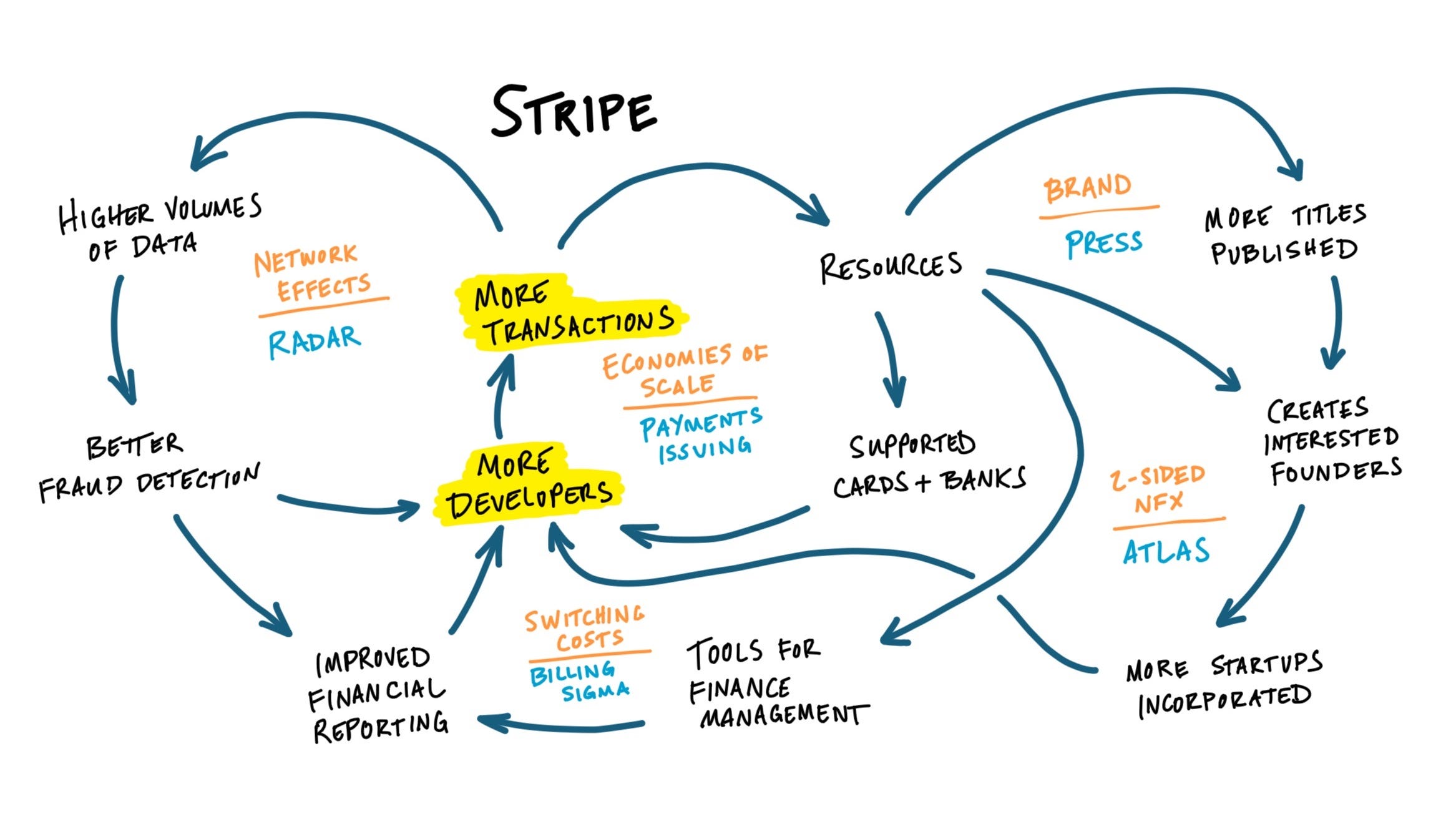
It reminded me of the ole’ Disney Corporate Strategy Chart—a tangle of arrows showing how movies feed merch, which feed parks, which feed media which end up feeding all the way back to: movies. A closed loop of cultural momentum.
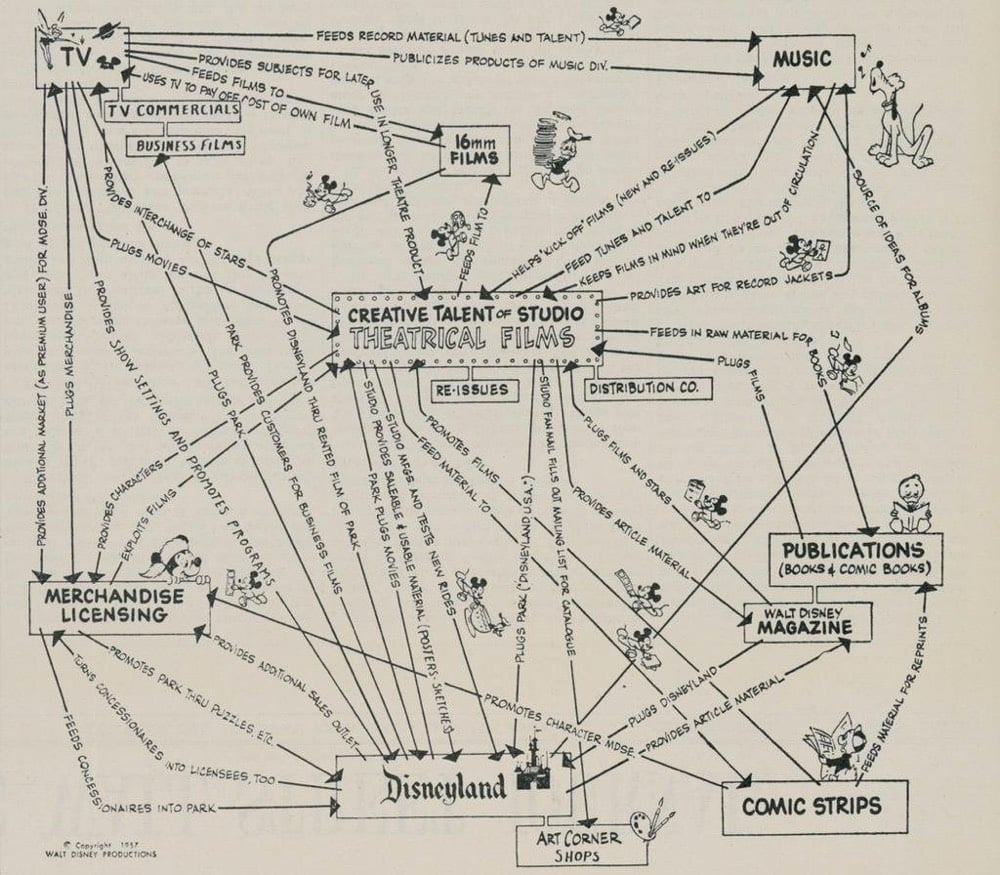
Disney’s former CFO Jay Rasulo put it starkly:
“Everything we do is about brands and franchises.”
Stripe isn’t building a franchise or a network of them, but I suspect something similar is happening on a quieter, more intellectual level: a belief that ideas, when circulated with care, create their own kind of flywheel.
A personal takeaway
Thinking about Stripe Press this way makes me wonder: What are the flywheels in our own lives? What systems are we unintentionally reinforcing—or could we intentionally design?
Not everything in life connects as cleanly as a Disney strategy diagram, or Stripe’s flywheel. But maybe the act of drawing our own charts, even roughly, can reveal where the energy is, where meaning accumulates, and where a small intervention –a project, a book, a side-quest– might change the trajectory of the whole system.
I see Stripe Press as one such “intervention”: a bet on the possibility that beautiful, ambitious books still matter in a world that seems to be moving further and further away from them, and that the future belongs to those willing to think expansively—and publish accordingly.