

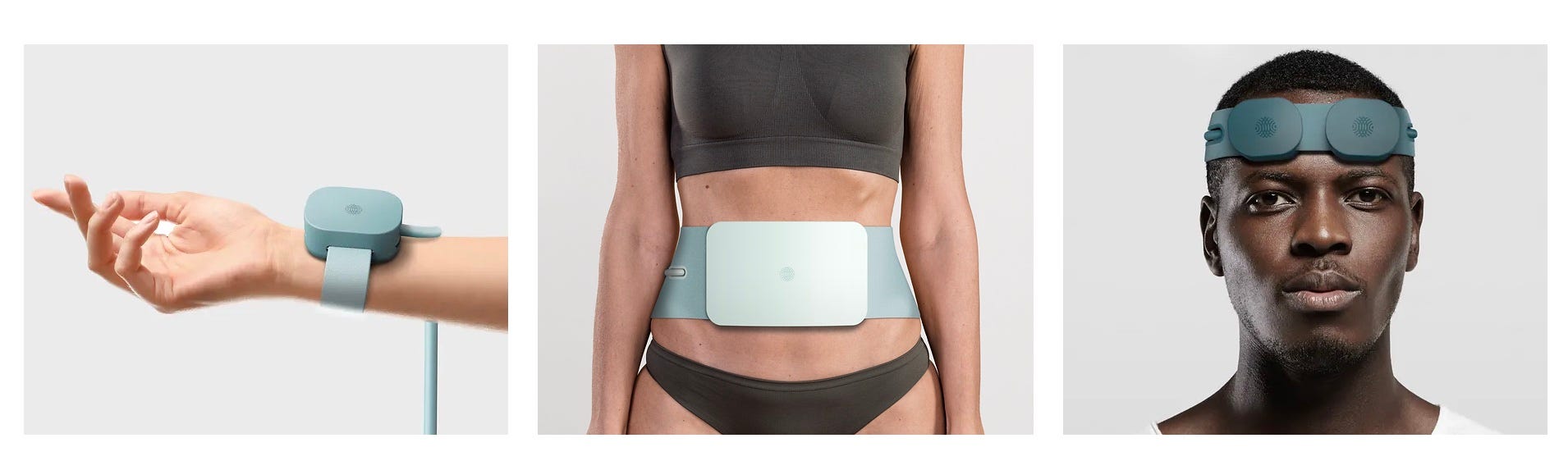
What’s cool about OpenWater.health?
Imagine you’re at a gala in a ball room full of people where an opera singer starts singing at a particular pitch, register and tonal quality. Her singing shatters a wine glass while everyone – and everything else– in the room remains untroubled.
Now imagine that same principle applied not to glass, but to the cells in your body—selectively targeting only the ones that make you sick.
That’s the metaphor OpenWater.health uses to describe its work: harnessing light, sound, and electromagnetism with high levels of precision to diagnose and treat disease at the cellular level.
Founded by Mary Lou Jepsen, a tech world pioneer with the most impressive resume you’ll find, she and her team are bringing the logic of mass consumer electronics into medicine—using the ubiquity of smartphone-class chips and global supply chains to replace the need for developing billion-dollar, custom-built machines.
The result: functional medical prototypes, like wearable caps that can perform MRI-like imaging or deliver tumor-shrinking therapy, at a fraction of the cost.
And here’s the kicker, and why I’m highlighting them here: they’re open-sourcing it all. If they are for real about their mission and approach, OpenWater isn’t just publishing code and patents—it’s trying to open the entire medical-device stack.
How, exactly, are they going about this? Here are a few examples: software is licensed under the AGPL license, hardware under Creative Commons BY-SA (remember, licenses are important!), and patents pledged for open re-use.
Even safety data and clinical protocols are shared in public wikis, with the aim of cutting the typical medical device development cycle from 13 years and $658M to something closer to 3 years and $10M.
Imagine many of these medical R&D projects happening consistently within these new and reduced budgets and timelines over the next decade, and the world suddenly looks much different. It makes medicine start looking a lot more like Linux (the open-source and predominant OS for servers and the world's 500 fastest supercomputers!) than Medtronic (the conflict-ridden manufacturer of pioneering cardiac devices).
OpenWater is betting that openness and mass-audience appeal can do for healthcare what it did for software—make the impossibly capital-intensive a whole lot more accessible, and the lifesaving more democratic.
What’s more exciting than all this promise? Some early results that prove that it’s not just hype (more on this later).
Singing their medical praises + a quick (and important!) regulatory reality check
To put it yet another, slightly more technical way, OpenWater is placing the following bet: by using mass-market smartphone-class chips and sharing safety/efficacy data across applications, device development can compress from ~13 years and hundreds of millions of dollars to something closer to a few years and an order of magnitude less money (JAMA analysis of PMA device costs/timelines; HHS overview cited in interview).
The org is unusually transparent about regulation, too: for example, you can read its FDA Breakthrough Device request and correspondence for its stroke device directly on GitHub (Breakthrough request PDF; deficiency response with clinical data).
Yet – there’s always something, right? – it’s important to remember that OpenWater’s model still has to live within existing device rules and regulators. The FDA’s new Quality Management System Regulation (QMSR) fully aligns U.S. device QA with ISO 13485 by Feb 2, 2026 (FDA QMSR FAQ; Federal Register notice). For connected devices, the 2025 FDA cybersecurity guidance also raises the bar on SBOMs, vulnerability management, and secure design (FDA Cybersecurity Guidance).
OpenWater’s “open” approach doesn’t bypass any of this. Instead, it is a different way to satisfy it, by sharing evidence and components so others don’t keep reinventing the same, closed wheel.
Geeking out on some early signals
What follows are some examples of clinical trails run by OpenWater.health:
Stroke triage, without a scanner. A multi-center study in Journal of NeuroInterventional Surgery evaluated OpenWater’s portable optical blood-flow monitor for detecting large-vessel occlusion (LVO) in suspected stroke patients. Among 135 ED patients across two comprehensive stroke centers, the headset achieved 79% sensitivity and 84% specificity, outperforming prehospital scales like RACE and LAMS—promising, but still needing validation in the prehospital setting it ultimately targets (PubMed abstract, medRxiv preprint).
Depression via wearable focused ultrasound. On the neuromodulation side, the team reported an open-label feasibility study stimulating nodes of the default mode network with low-intensity focused ultrasound (LIFU). In an initial 20-patient cohort with severe major depression, they observed significant symptom improvements; the authors explicitly call for randomized, controlled trials to confirm efficacy and durability (Frontiers in Psychiatry: study overview + caveats). Underlying this is a technical advance: a wearable, steerable tFUS headset, described in the Journal of Ultrasound in Medicine, designed to hit targets through the skull with a matrix array and neuronavigation (J Ultrasound Med paper listing on OpenWater clinical page — article: “A Wearable, Steerable, Transcranial Low-Intensity Focused Ultrasound System”).
Why this feels different: Compared with MRI-guided focused ultrasound (e.g., Insightec’s Exablate Neuro, FDA-approved for essential tremor and expanding indications), OpenWater’s tFUS aims for portable, non-MR targeting—closer to a headset than a suite-anchored procedure (FDA PMA record for Exablate; Insightec overview: company page). On the stroke side, alternatives include imaging (e.g., Hyperfine’s portable low-field MRI) or ultrasound on a chip for POCUS (e.g., Butterfly)—each democratizes access in different ways and with different tradeoffs (Hyperfine; device overview + cost context; Butterfly background). In depression, clinician-adopted comparators exist today: rTMS/Theta-Burst (non-invasive, modest-to-moderate effect sizes) and emerging, invasive DBS protocols still in trials (Abbott/TRANSCEND).
The novel angle isn’t just what they’re testing; it’s how: making the designs and safety paperwork broadly re-usable so multiple centers can iterate faster on where ultrasound and optics work best. If that reduces duplicated engineering and expands the dataset regulators see, the pathway could look very different than one company grinding through one indication at a time (MedCity News op-ed by Jepsen).
And now, let’s allow ourselves some speculations…
What could change for the better if OpenWater.health succeeds?
Faster translation, broader access. If an open, componentized platform proves out, labs and startups could stand on shared hardware/software and shared safety/effectiveness evidence—directly targeting a status quo where novel PMA-class devices can take a decade+ and large capital outlays to reach patients (JAMA PMA cost/time study / PMC).
Prehospital stroke triage that routes the right patient to the right hospital. Even incremental gains over clinical scales can translate into minutes saved and better outcomes if validated in the field. The JNIS results are an encouraging step, but the ambulance is the proving ground (JNIS study; broader LVO prehospital review: systematic review/meta-analysis).
A new, non-invasive neuromodulation option. If randomized trials confirm efficacy, wearable tFUS could complement rTMS and medication for depression with better focality/depth than magnets allow, without DBS surgery (Frontiers depression feasibility; general reviews on ultrasound for depression: 2025 review).
A public-goods rhythm to medical devices. Open designs + patent pledge + shared regulatory artifacts set a precedent: competitive businesses on top of commons infrastructure. The upside isn’t ideological; it’s practical—more shots on goal per dollar (Openwater open-source + patents; Inside Precision Medicine).
What could go wrong, plus some open questions…
Clinical evidence still early. The stroke headset outperformed scales in-hospital; field performance, workflow fit, and impact on outcomes are unproven. The depression data are open-label; sham-controlled RCTs with durable follow-up are essential before broad claims (JNIS details; Frontiers caveats).
Safety, governance, and “cowboy” risk. Open hardware lowers barriers for good actors and risky ones. Strong quality systems (QMSR/ISO 13485), SBOMs, secure update pipelines, and post-market vigilance are table stakes for any connected device (FDA QMSR; FDA Cybersecurity guidance; HHS OSS risk note: PDF).
Market and reimbursement realities. Incumbents already sell cleared alternatives: MR-guided FUS (Insightec) for tremor/Parkinson’s, portable MRI (Hyperfine) for bedside imaging, widespread POCUS (Butterfly) for rapid exams—each with known CPT/reimbursement paths and clinical familiarity (FDA PMA Exablate; Hyperfine resources; Butterfly background: Jefferson paper). OpenWater will need not only data but business models that make procurement, training, and service simple.
IP clarity over time. A patent pledge is powerful, but it must be legally durable and operationally clear as new filings and contributors join (watch how the pledge and licenses evolve: Openwater patents page).
Selected Sources
Open model & patents: Openwater Open Source · Patent Pledge
Regulatory transparency: Openwater clinical page · JNIS PubMed