

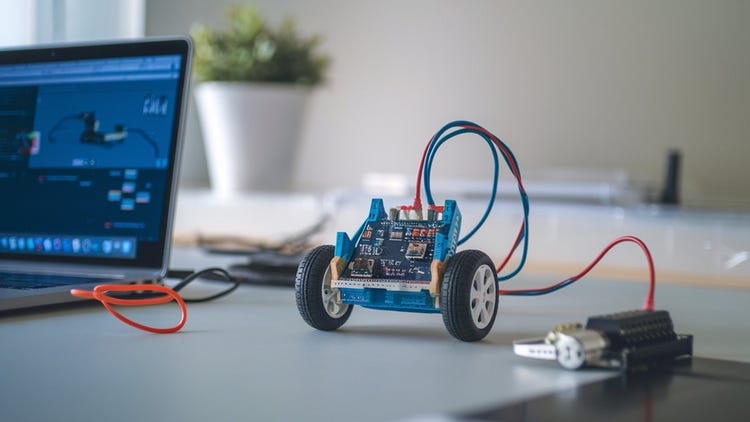
What’s cool about Arduino?
If you’ve ever played with electronics, there’s a mighty-high chance you’ve crossed paths with Arduino. (And if not, you’re definitely doing it wrong).
What started in 2005 as a scrappy master’s thesis project at the now-defunct Interaction Design Institute Ivrea (IDII) in Italy has since grown into one of the most influential open-source hardware organizations (movements? shall we call it a movement?) in the world (Wikipedia, Arduino).
The founders—Massimo Banzi, David Mellis, David Cuartielles (and others; this is a contentious subject, more on that later)—wanted a simple and affordable “system” for design students to prototype interactive ideas.
The result was a microcontroller board anyone could program with via an easy-to-use IDE that abstracted away the often complicated details of electronics so that people could focus on their own objectives.
From blinking LEDs – the “hello world” of electronics – to robots and satellites, Arduino became the launchpad for millions of experiments.
Arduino is the kind of organization – and product, platform and community – that simply wouldn’t exist without open source, and it embodies its essence like almost no other open-source org out there.
It lowers barriers, builds community, and empowers people everywhere to turn imagination into reality. It has survived internal conflicts, embraced new directions, and kept its identity rooted in making electronics easy and accessible. Whether you’re a kid wiring your first sensor or an engineer designing industrial IoT, Arduino makes building, playing and learning with electronics possible, and more human.
Attribution is messy
Before we continue, a quick word on attribution. Attribution is a tricky business in areas like marketing, the arts, archeology, evolutionary biology, science and academia – but it can get especially sanguinary (h/t to DC for leading me to the right word here) in the worlds of open source hardware and software.
I’ll let you come up with your own conclusions but, at the very least, Hernando Barragán deserves to get credit for starting Wiring as his master’s thesis project at IDII. His work served as necessary groundwork for Arduino to exist. Putting it bluntly: Wiring is Arduino’s amniotic fluid.
On that note, The Untold History of Arduino is a great read. In it, Barragán himself shares his side of the story, and that dives deep into the particulars.
I’d like to highlight Wiring’s original objective, which I’ve alluded to before:
to make it easy for artists and designers to work with electronics, by abstracting away the often complicated details of electronics so they can focus on their own objectives.
Beautiful. Whatever economic system we come up with should encourage and reward this kind of project.
From a tiny Italian classroom to a Global Movement
I guess we are calling it a movement after all.
By 2020, Arduino counted 30 million active users worldwide, with 300,000 official Arduinos commercially produced, and 700,000 official boards in users' hands. (Wikipedia). Its boards are now staples in classrooms, labs, and makerspaces the world over.
And in case you care about rankings, Time Magazine sets Arduino at #9 in the 2025 World’s Top EdTech Companies, underscoring its role in transforming how STEAM is taught (Arduino Blog). Nobody should pay too much attention to rankings like these, but transforming STEAM education is well worth celebrating.
I’m glad to highlight Arduino here. The org is proof you don’t need to make learning (about electronics, in this case, but maybe anything) something that’s elitist or expensive in order for it to be wonderful.
How to stay open-source through hell and high water?
At its core, Arduino is about more than boards and kits—it’s about openness, democratization if you’re more keen on that term. Both their hardware and software are released under permissive licenses, inviting remix, rebuild, and re-imagining (Arduino). The community—millions strong, truly—shares code, schematics, tutorials, and inspiration freely.
But openness always has its costs and tensions. And we should always be thinking in degrees of openness (as alluded to before with Barragán’s Wiring project lacking the proper recognition). But there’s more: Arduino weathered a trademark dispute and organizational split in the mid-2010s before reuniting as Arduino AG.
This saga highlights a persistent challenge: how does a mission-driven open-source organization protect its identity, sustain itself financially, and still honor community contributions so that contributors remain engaged? (Hackaday)
These questions aren’t unique to Arduino, but its willingness to evolve governance while staying committed to open access is part of what keeps it “cool”. They provide fertile ground for many a “lessons learned” for makers, engineers, entrepreneurs and curious learners in years to come.
I’ll say one more thing on this topic…We can treat this as evidence that open-source can be a strategic and/or necessary phase in the lifecycle of an organization. Organizations open up or close down behind shut doors out of necessity but/and also due to strategic pivots and updates to their goals and objectives. Even a change in staffing members can be the deciding factor in moving towards openness or closed-ness.
Looking Ahead
Arduino is now a mature, well-heeled organization, one pushing boundaries in education, IoT, and industry. In classrooms, kits like Arduino Alvik provide hands-on ways to spark creativity and problem-solving in STEM (Elektor). In industry, Arduino unveiled Rileva ME, a wireless sensor for predictive maintenance, alongside professional learning paths at the 2025 Automate conference (Automate.org).
With this launch as an example, we can also see amateurization and professionalization going hand in hand. The narrative that open sourcing a project lowers the value of each contribution by increasing the pool of contributors is only one side of the story. More people, too, have the opportunity to professionalize, if the project is “guided” to that end.
Arduino as an org also champions an IoT Manifesto built on fairness, openness, and sustainability—an antidote to the corporate “black box” approach to connected devices (Wired). This transparency is essential to the world, and our fights for the right to repair need to be backed up by our will to repair – to tinker, learn and pry those sealed electronic boxes open.
In research, Arduino is finding its way into surprising places—from soft robotics to air-quality monitoring (arXiv, PMC).
My hope is that learning a bit more about Arduino gets people thinking about do’s and don’t’s when considering joining, starting, backing or contributing to an open source project and community.