

I must highlight the org without which Prusa Research, the org from my previous post, wouldn’t exist.
What’s cool about RepRap?
If you own a 3D printer, or ever considered buying one, you can thank RepRap.
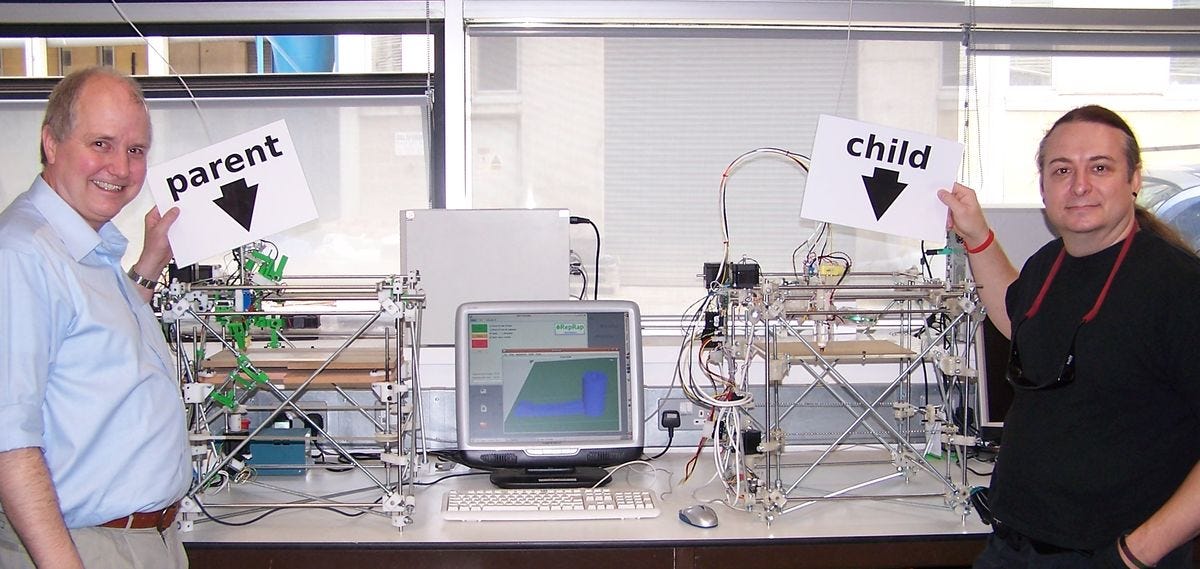
RepRap is short for: self-REPlicating RAPid prototyper 3D printer, and also how most people know the open source community behind the project. What I love most is that RepRap is one of those rare idealistic organizations with strong values that has unleashed a wonderful innovation into the world by making it affordable by design.
3D printing is a form of additive manufacturing (AM) that uses fused filament fabrication (FFF) technology, where a single layer of polymer – materials made up of many simpler molecules like cellulose (made up of simple sugars), natural rubber and plastics – is deposited after another.
But before the explosion of 3D printers small enough to fit atop your desk, a 3D printer was a massive machine that only highly-specialized manufacturing companies could justify owning and operating, since they’d run you north of USD $20,000.
The goal of the RepRap project and community has always been to create an cheap-enough 3D printer: a self-replicating machine that was capable of creating 50% to 70% of its own parts, with the remaining components easily and affordably sourced.
And they succeeded immensely. RepRap’s open source hardware approach resulted in the creation of the first desktop 3D printer, a dramatic decline in costs and an explosive early adoption by hobbyists and makers, primarily using these machines for rapid prototyping.
They allowed people like Josef Prusa, founder of Prusa Research, to start tinkering with these machines and their capabilities, and by doing so, in turn, expanding their possibilities.
Thanks to RepRap, and with a little bit of tinkering, you can now own a 3D printer that runs on your home desk for USD $500 (or even less).
If you own one, I’d be curious to know what might’ve convinced you to get one. And if you don’t, I’d be curious to know if you’d consider buying one, and why. After all, there are a number studies (like this one and this other one) showing that owning a 3D printer and printing common household goods, has an ROI of more than 100% in five years. And hobbyists who own 3D printers absolutely love them.
The strangeness of open source 3D printing economics
Economics is most often thought of too abstractly, too narrowly. Inflation, taxes, interest and exchange rates. Sure, those are important. And supply and demand, opportunity costs etc…, those are important too.
But just like history is, fundamentally, all about “what happens”, economics is all about “how we behave”. Often “how we behave” is puzzling enough that it turns out to be much more fertile ground for analysis and understanding than trying to get at the root of “why” we might behave the way we do.
This is all to say that economics is complex, multi-faceted and unequivocally bereft of simple, straightforward answers. That there’s so much more to the story than dictums like “capitalism is a terrible system run by profit-starving pigs who can’t get enough of making more money” or “socialism is misguided and always leads to communism” or “tax the rich” (for example, in the name of social justice) or “increasing the number of dollars circulating always results in higher inflation“ (most of the time, probably, but not axiomatically).
If I learned one thing as an Economics student in college, the best answer is always: “it depends”.
There are obviously observable and predictable phenomena that economics can, and does, explain accurately. What I am advocating for is that we think more deeply and more critically when we hear these seemingly conclusive statements about our economic systems.
If we base our reasoning about our economic systems on premises like “people are primarily motivated by money” and “more money makes people bad”, then we stand to be wrong in our understanding of a lot that happens in the world. We can’t believe in these one-liners and also glue bumper stickers urging others to “shop local”.
If capitalism were such a terrible system as to be utterly immoral, then we wouldn’t have people like Adrian Bowyer pouring their hearts and souls into an open source project like RepRap that stands to make him zero dollars.
Capitalism has many flaws. Of course, if we could improve upon this system, perhaps there would be more people like Adrian. Or perhaps we would need people like him, and projects like Rep Rap, a bit less.
But I’m still grappling with the economics of open source, it’s existence at the height of “late-stage” capitalism. It is clear to me that the relevance of open source is increasing. That it is both enabled by capitalism, and set in direct opposition to most of the capitalistic goals. I strive to continue deepening my understanding of it, and sharing what I learn along the way.
We love or hate stories of rags to riches, but we have a much harder time assessing and celebrating the economic impact of contributions from organizations like RepRap. I’m certainly at fault here, and trying to remedy that.
My sense is that although 3D printing seems like a thing of the near past for most people, on the decline after it peaked in 2018 and certainly a much less exciting technology than AI, we still haven’t seen the economic effects of its “full potential” (what that means, I’m not sure, but think distributed manufacturing and distributed peer production).
There’s another “lesson” I learned as an Econ student that is best summarized in this quote from Henry Hazlitt:
The bad economist sees only what immediately strikes the eye; the good economist also looks beyond. The bad economist sees only the direct consequences of a proposed course; the good economist looks also at the longer and indirect consequences. The bad economist sees only what the effect of a given policy has been or will be on one particular group; the good economist inquires also what the effect of the policy will be on all groups.
But 3D printing is maturing before our eyes.
It has impacted the toys and games industry, for example: MyMiniFactory, just a single 3D printing repository among dozens, is saving consumers well over $60 million a year in offset purchases.
It has empowered scientists to create new experimental laboratory equipment and tools.
And it is going mass market, with a bunch of companies, like Bambu Labs – which you might love or hate, depending on where you stand on the morality of not playing by the rules of open source – driving costs down and making printers even more user-friendly and plug-and-play, more like kitchen appliances. 3D printers are the new microwave, the new air fryer.
This revolution is happening in great part thanks to RepRap, an open source hardware project. How strange indeed.