

What’s cool about this org?
Prusa Research (aka Prusa) is an incredibly prolific 3D printer manufacturing company that has recently taken definitive steps away from open source.
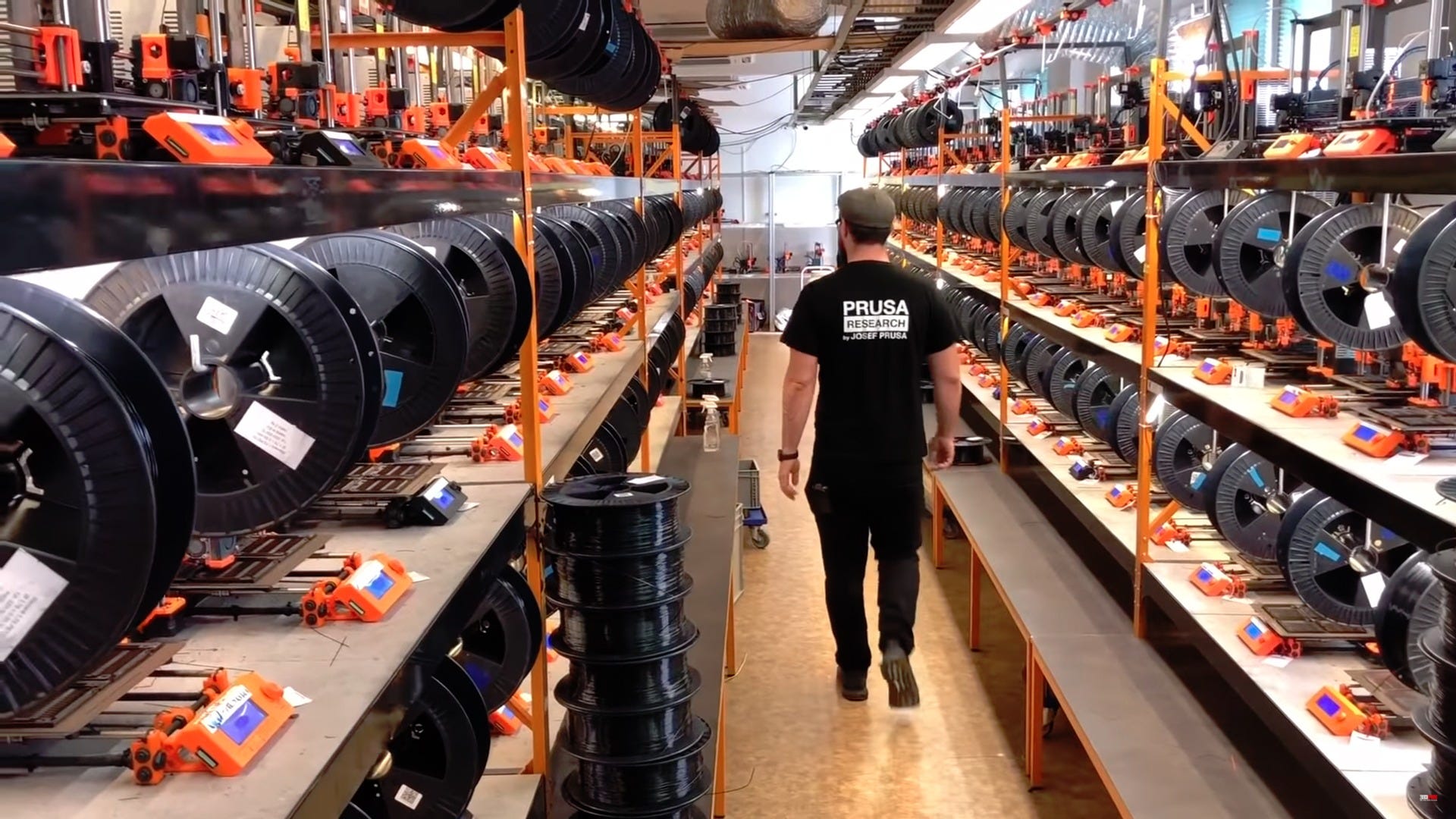
Founded in Prague, Czechia in 2012 by Josef Prusa, the company employs over 1,000 people who are – mostly – working out of a single, incredible HQ and manufacturing facility, developing software, filament and making 3D printers.
(Prusa is also the company behind PrusaSlicer, PrusaMent and Printables)
Prusa is built “on top” of a wonderful open source project: RepRap. Josef and his brother were heavily involved in, benefited from and contributed to the RepRap open source projects and community prior to starting their own company.
But things changed around 2023, with the company partially abandoning their open-source ethos due to competition from others, and releasing their first two 3D printers that were not 100% open source.
Echoing Josef’s words in his state of open source hardware discussion of 2023:
The open-source movement relies on the fact that everyone involved plays by the same rules.
These rules are difficult to enforce, and largely unattractive to competitors who “poison the well” of goodwill built by open source communities.
But/and “open source” can also be an excuse.
In the words of Armin Ronacher:
For the price of one Prusa MK4 with shipping I could buy three Bambu A1 printers or two Bambu A2 printers plus the AMS addon which adds multi-color printing.
There is absolutely no reason to buy a Prusa MK4 today unless you want to support Open Source or a European company (Prusa is from Czechia).
Wether Bambu Lab and other manufacturers are playing nicely or not remains an open question. Of course Prusa wouldn’t be happy about it, especially if Bambu Lab and others are filing patents in their own countries, backed by hungry, potentially unfriendly governments.
But things change. Open source tends to evolve in a cycle of "amateurization”: companies and organizations make distribution better, wider and easier, lowering the bar for more and more people to participate, thus increasing the numbers of amateurs and late-adopters.
Who is to say that we – consumers, makers, prosumers – don’t benefit from simpler, easier-to-use powerful 3D printers like Bambu’s flooding the market, enabling more people to get into 3D printing?
It remains to be seen.
A few insights
“Open source” is a dynamic, evolving concept
“Open source” is also loosely and vaguely interpreted by different companies and jurisdictions around the world
The amateurization cycle is embraced by those who usually stand to gain from it, and decried by incumbents and purists
Licenses are critical components dictating outcomes in the shades-of-grey spectrum of open–to close–source
Open source business models are challenging to sustain, while open source remains an attractive component for companies, particularly at their earlier stages
Convenience usually triumphs over the principles of purists
Manufacturing matters
We’ve been able to run a printing press from our home offices since the advent of home printers. With modern 3D printers like Prusa’s, we can essentially run a small, nimble factory.
Along with a PC or laptop, that’s three revolutions in history cozying up on your desk, accessible as packaged machines requiring little more than a few clicks to run in our homes, reliably, powered by affordable, reliable electricity. With the entirety of internet to learn from…(and without even getting into AI).
A study from 2017, for example, made the following claim about American households and 3D printers:
Buying a 3-D printer represents a return of investment of over 100% in five years.
My sense is that the real revolution with these technologies is yet to come. That the constraints to our thinking, imagining and creating are slowly…vanishing.
I hope we can skillfully navigate the noise, the confusion and the fear-mongering, and come up with protocols and standards that foster experimentation, learning and a better relationship with the environment.