

Read ‘til the end for some fantastic plastics projects and a call to action for September 1st, 2025
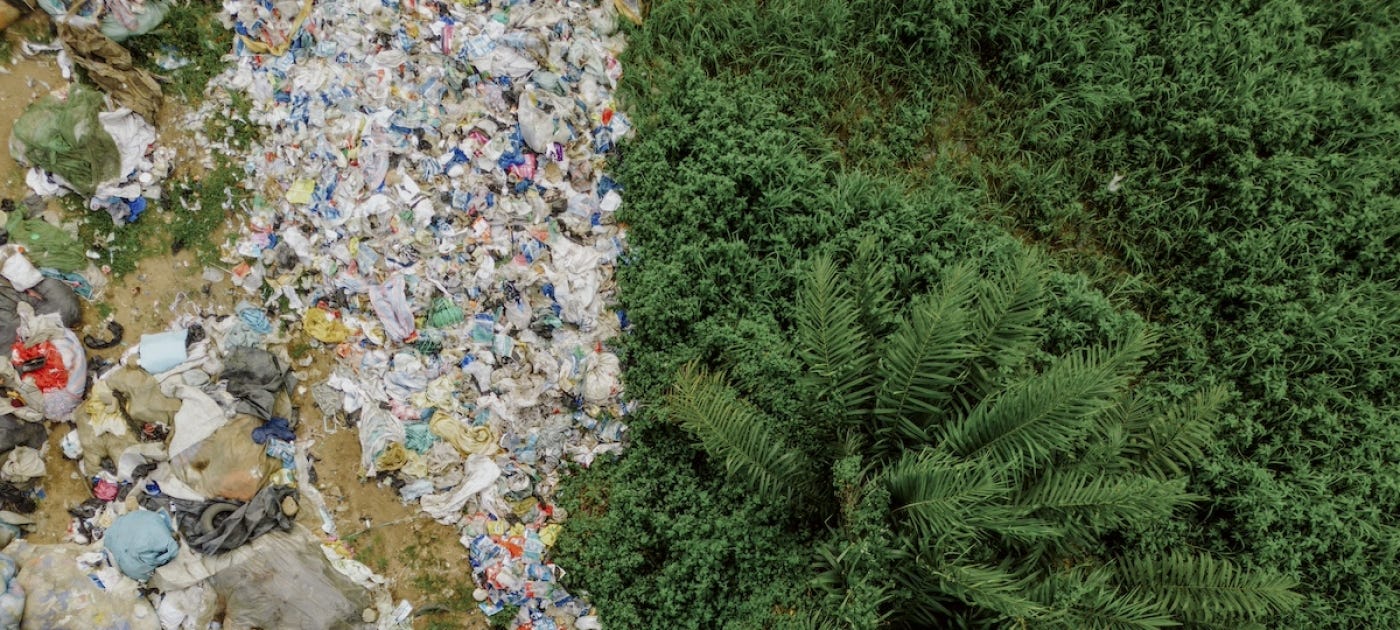
What’s cool about this org?
Precious Plastic is a wonderful open-source, community-driven organization that helps people build businesses from plastic waste.
They do other really cool things, too, like share R&D findings about how to turn organic materials (like food waste) into biodegradable products like plates, bowls or cups.
Plus, it’s also cool to see how organizations form and evolve relative to the challenges they’re trying to tackle.
Per the organization’s website:
Our solutions see people as the key element to fix the plastic mess. Precious Plastic approaches count on people to bring about the necessary change. Small steps, multiplied by millions. That's where we can win our battle.
We don't believe in techno-utopian, fix-it-all, dream technology.Precious Plastic is a combination of people, machines, platforms and knowledge to create an alternative global recycling system.
It’s an impressive grassroots organization leveraging the power of the internet and open source ethos to “share all the outcomes of our research & development online”.
But, also…
Precious Plastic is In Trouble
That’s right. For all the amazing work they do, they are also at a pivotal moment. In their own words, the org is at “an important breaking point where we either give it a big boost or it will die”.
You can read more about it here.
I highly recommend giving that a read. Open-source, community-driven organizations are vital, now more than ever, and Precious Plastic has been running one for a while.
They’ve succeeded in their mission of building a global community of recyclers, and now they are at a crossroads and have some lessons learned to share.
They have set September 1st, 2025, as the date in which they will announce the future plan for Precious Plastic.
Plastic (and plastics reciclying) is contentious
Oh and by the way…plastic production and waste are intimately related with climate change, which is of course a highly politicized issue, but this post has no political agenda.
To put it bluntly, I don’t care about politics and other people do politics better than I do.
My position on this is best summarized by Tim Urban from Wait But Why:
Let’s ignore all the politicians and professors and CEOs and filmmakers and look at three facts:
Fact 1) Burning Fossil Fuels Makes Atmospheric CO2 Levels Rise
Fact 2) Where Atmospheric CO2 Levels Go, Temperatures Follow
Fact 3) The Temperature Doesn’t Need to Change Very Much to Make Everything Shitty
Now that that’s out of the way, let’s move on. But/and before we dive more deeply into Precious Plastic, let’s set the stage for the severity and scale of the problem.
It is so sticky a problem, in fact, that it serves as a perfect-storm example of the kinds of problems we will be forced to face as a global human civilization.
Some facts about plastics (and we won’t even get into microplastics):
400 million tons of plastic waste are produced worldwide each year, but only 5-6 percent is recycled.
Plastic usage and waste have been on the rise for the last 30 years
Significant stocks of plastics have already accumulated in aquatic environments, with 109 Metric tons (Mt) of plastics accumulated in rivers, and 30 Mt in the ocean.
Plastics have a significant carbon footprint, contributing 3.4% of global greenhouse gas emissions throughout their lifecycle. In 2019, plastics generated 1.8 billion tonnes of greenhouse gas emissions, with 90% coming from their production and conversion from fossil fuels.
– via OECD, Global Plastics Outlook
And here’s a lawsuit filed by California’s Attorney General against ExxonMobil for allegedly engaging in a decades-long campaign of deception that caused and exacerbated the global plastic pollution, and sheds a light on the petrochemical industry’s role in the plastic pollution crisis.
The jury is out on whether plastic recycling moves the needle or not. In the meantime, orgs like Precious Plastic are taking matters into their own hands instead of twiddling their thumbs.
On the emergence of structure relative to challenges-to-be-tackled
A quick sidebar…I’d like to think that there’s a latent contribution to the theory of organizations here… My modest start towards that is that an organization’s structure – from it’s hierarchy (or lack thereof), to its cadence and rhythms, incentives, metrics etc… – is in constant reciprocity to the challenges that the organization is tackling.
In short, that Precious Plastic’s structure could be plastic-y. That its structure mirrors, say, plastic waste’s ubiquity – 400 Metric tonnes of plastics are produced every year. Or plastic’s stickiness – it takes anywhere from 20 to 500 years for plastics to decompose, depending on the material and structure.
I’m sure this happens implicitly with organizations of all kinds. Data centers and their anonymous architecture and secretive, inconspicuous pervasiveness is one example that comes to mind. Bit what if this mirroring was made explicitly, as a conscious choice?
Glorified waste, precious solutions
It’s brilliant. To treat plastic as a precious material, “to turn waste into wander”.
Through Precious Plastic, you can:
Learn to start a business from plastic waste and/or your own recycling center
Learn to build DIY machines to recycle plastic waste
Buy and sell your own machines
Get the latest from the biodegradable materials R&D
Learn how to make furniture, construction materials, modular structures and high-precision moulding
I highly recommend perusing their website and online community
Lessons from running an open-source, community-driven organization
I’ll mention this again here because I think it’s worth a read:
Precious Plastic is In Trouble. Don’t want to click a link? That’s fine. Here’s an excerpt:
#5 Open Source community
[…] We went all-in on giving. And believe(d?) that sharing Open Source will bring contributions back one way or another. Contributions to support the Precious Plastic Community can be made in various ways. And many members do contribute something back which is great. However we’ve also been observing quite some established organizations that take more than they give, building business around Precious Plastic but not contributing anything back. It’s allowed, since it’s all Open-Source. But the mentality of only taking things and not contributing will eventually kill a community-driven project like this.
#6 It is bad designed
We don’t blame those for not contributing enough back. We see this as a fault on us. The project wasn’t designed to have a healthy financial model and relation with the community. We were always fully focussed on giving to the community, not us being a financially sustainable organization. Funny example of this is the recent PPOSF (Precious Plastic Open Source Fund). We received a €100K donation. Which was amazing, but we decided to give it all to the community so they can continue developing their projects. Not to sustain the organisation itself. You could see this as a humble move from us, give it to the community. But it isn’t, it’s ineffective, because now we have to bother you with our problems. Ideally we don’t have to do this and you don’t have to worry about us.
#7 No long term team
As you can imagine all of the above problems make it hard for a team member to have a long term perspective in Precious Plastic. Even though the team has been very small, effective and works with many volunteers it has continued to be a struggle to pay everyone every month without worrying. Over time this brings lots of stress and uncertainty, especially if the team members by themselves grow up and need more stability in life.