Most cyclists don’t need fancy gear. A cheap, used bike can deliver a lifetime of joy.
And yet… there’s something compellingly subversive happening in the world of bike saddles—something that’s about far more than gear.
It’s about craft, and local manufacturing, and rethinking how things get made in a world obsessed with efficiency and sameness.
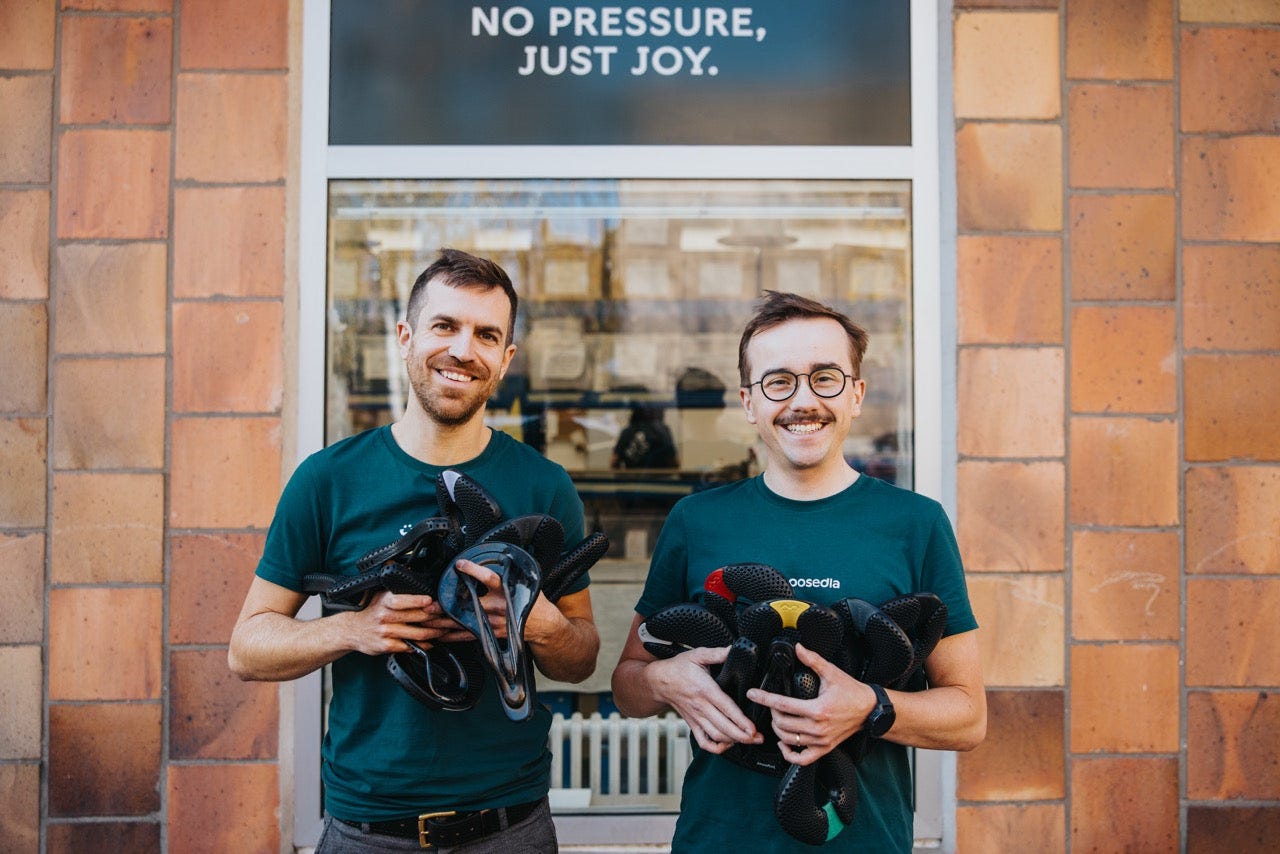
(Massive thanks to Oto Vavrek and Jiří Dužár, Posedla co-founder, for answering
questions over email.)
What’s cool about Posedla?
A lot of companies claim to make “custom” products. Posedla has actually built their entire business model around it.
Their flagship saddle, the Joyseat, is more than a 3D-printed gimmick. It sits on three pillars that feel refreshing and daring when considering the future of businesses all over the globe:
Mass customization
Localized manufacturing
High-quality craft
Mass Customization — A Saddle Shaped by You and Your Data
Your fingerprints are unique. So is your butt. Why, then, are most bike saddles mass-produced to ignore this? Manufacturing capability, at least, is no longer the excuse, although costs and economies of scale might still very well be valid.
While competitors like Fizik and Specialized adjust an existing shape, Posedla starts from zero—every time. Every saddle is unique because every rider is unique.
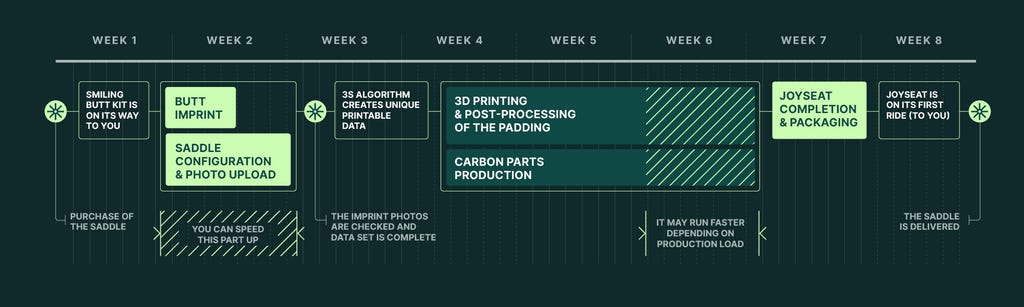
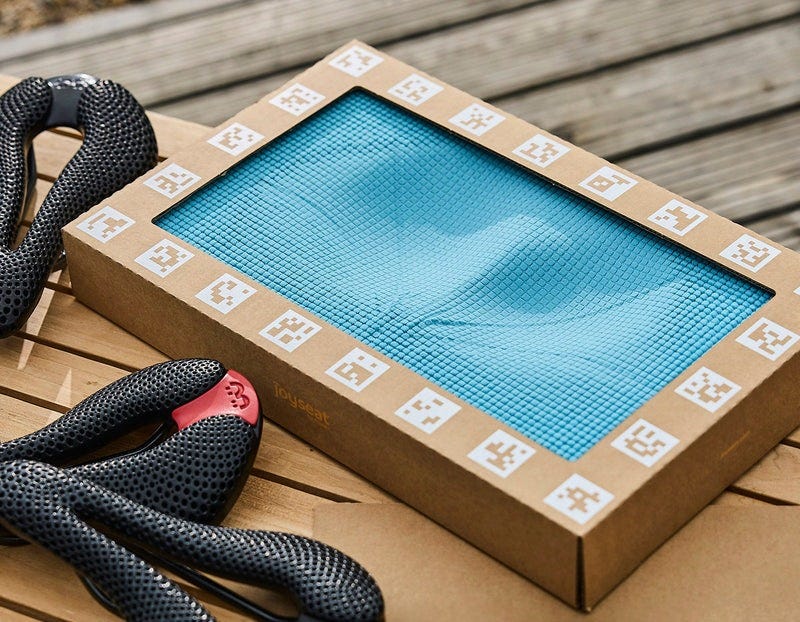
It all starts with your butt imprint. You receive a Smiling Butt Kit –yes, that’s the real name– sit on the imprint, and send your data back. Their 3S algorithm then generates a saddle that matches:
your width
your posture
your riding style
your dynamics
your pressure distribution
They then tune stiffness by zone, using complex lattice structures that would be impossible to manufacture by any means other than 3D-printing with high-quality TPU (i.e: 3D-printing filament).
This process results in a saddle that feels nothing like a generic piece of gear with its litany of soreness and just-not-right-enough fit, and more like a conversation between your unique body shape and a manufacturing process designed to support it.
Localized Manufacturing — Craft, Proximity, Accountability
This is where Posedla gets even more interesting.
3D-printing allows them to keep production local, in North Bohemia, Czech Republic—close to the riders they serve and close to the craftspeople who understand the product.
Why does this matter?
Shorter supply chains means lower transportation footprint
Tighter quality-control loops
Real accountability when something goes wrong
Here’s an example that illustrates this beautifully:
The 3D-printed top layer (the padding) bonds to a carbon fiber shell. If that padding ever wears out or doesn’t feel right?
They can remove it, recycle it, and reprint a new one on the same shell.The value—and the material—stays in the region. Not on a container ship.
This is the opposite of the globalized, anonymous supply chain where most cycling gear is born. It’s modern tech married to a long-standing tradition of craftsmanship and sensibility.
High-Quality Products — And the Tech and People Behind Them
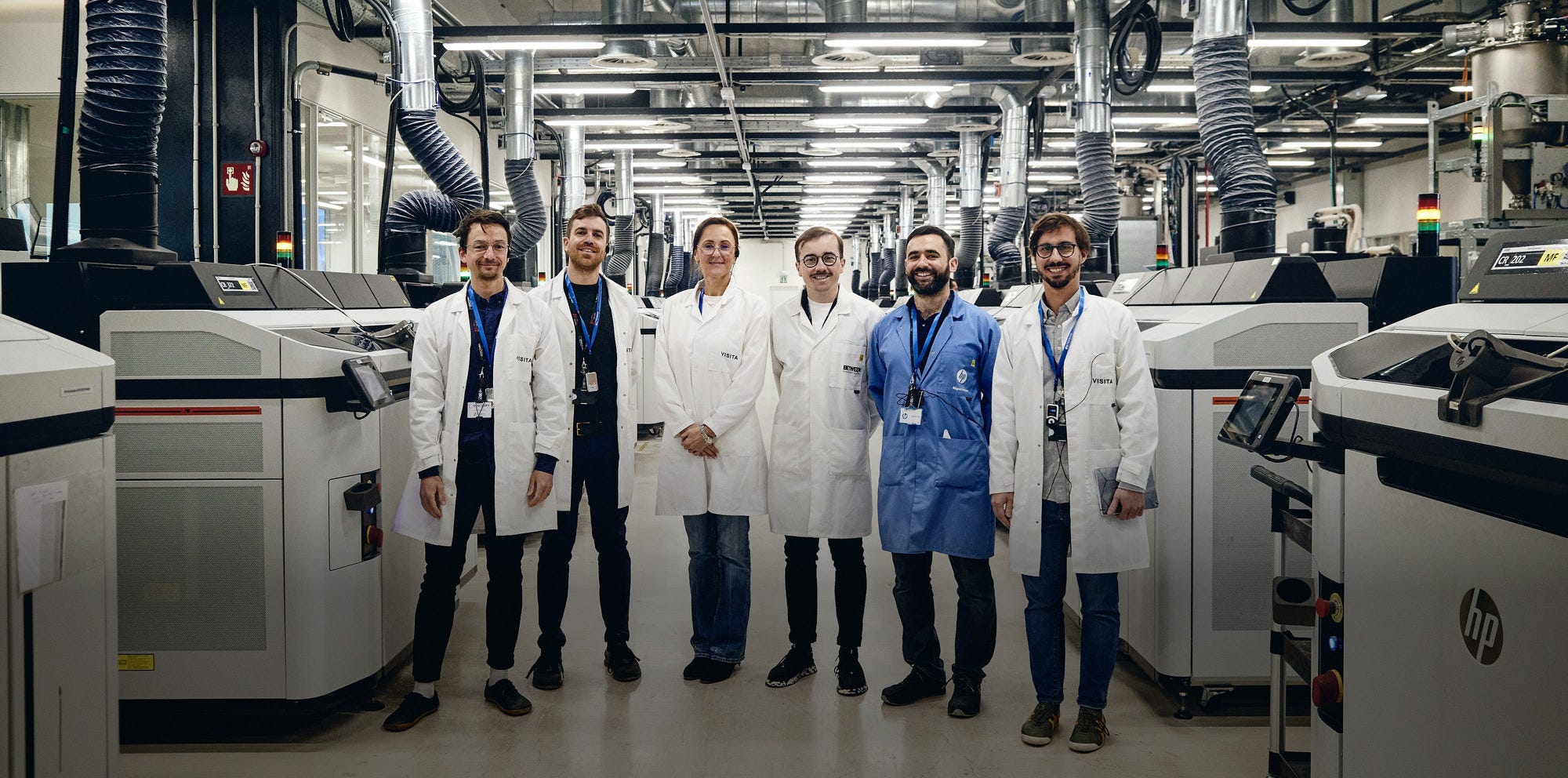
Posedla partners with a German company “down the street” and just on the other side of the border, to print the Joyseat’s flexible top layer. Their manufacturing process is deliciously nerdy and full of science and R&D.
Their process uses HP Multi Jet Fusion printers with TPU powder from BASF, resulting in a stronger and more durable polymer structure than UV-cured alternatives.
They can print details with 0.22 mm accuracy. This means your saddle isn’t just custom-shaped, but truly custom-crafted.
This 3D-printed top layer is attached to a “shell”. This shell is made of carbon fiber is handcrafted at Posedla’s workshop—the kind of detail that reminds you that bikes used to be things people built rather than things factories spit out.
Sustainability — Progress, Not Perfection
Let’s address the Big S for a moment…
Posedla works mostly with TPU and carbon fiber. TPU is recyclable; carbon fiber is much more difficult.
Their current approach:
TPU padding: remove → recycle → reprint → reuse
Carbon fiber: currently recyclable only into less demanding products (like carbon wall clocks!) until better tech emerges
Is this perfect? Of course not. No one is doing it perfectly. Not even Patagonia (this article by Kyle Frost is an excellent read, by the way).
Here’s where I land in all this, because despair is simply not a viable strategy:
We remain skeptical because greenwashing is real.
But we should also be fair and rationally optimistic—progress matters much more than perfection, especially when a company is honest and transparent about its limitations.
Posedla is not solving climate collapse. But they are doing one thing beautifully: moving toward circularity in a space where most companies don’t even pretend to try.
In this game of inches, inches add up.
What Can We Learn From Posedla?
1. Demand better—from the companies you already support
By all means: count your blessings! Be content with what you have and be easily satisfied in your life.
But that should not apply to companies who have earned your trust and your business. Keep them accountable towards this end: doing better. For their employees, for their customers, for their communities, for the planet.
2. Get a bike fit and learn your body
Cycling pain is complicated and tends to follow this tricky maxim: “pain whispers before it screams.” Understanding your biomechanics is transformative, regardless of whether you eventually buy a Joyseat or not. This is especially true in activities like cycling and running with a ton of repetitive motions.
3. Back the builders, not the behemoths
Write a review (they still kinda matter). Share an artist’s work. Buy from a small business.
Private enterprise has never been the problem. The issues lie with concentration and abuse of power, crony capitalism, narrow-minded-and-short-sighted corporations, and myopic, lethargic and outdated government structures.
Companies like Posedla thrive when communities champion them.
The Bigger Picture?
A bike saddle is a small thing, trivial. But sometimes small things reveal deeper truths.
That we deserve products that remember us.
That manufacturing doesn’t have to be anonymous.
That sustainability can be real—even when imperfect.
That technology can bring production back home instead of sending it away.
And that a simple piece of gear can remind us what good craft feels like: something made with care, for a particular person, in a particular place by people who care.
But wait, there’s more…
For a parting gift, check out this bit of intriguing history situated in Varnsdorf, Posedla’s hometown in North Bohemia, Czech Republic.