

Before you dismiss this as “yet another crypto scam”, I encourage you to read the first section and then the “How it compares to other NFT drops and DAOs” one.
Consider, for instance, how most of us worry so damn much about these pieces of paper with no intrinsic value and printed with the faces of dead people…
What’s Cool About NounsDAO?
There’s a lot to go through here, since NounsDAO is many things at once — an NFT project, an open-source brand, an online community, a treasury, and a funding body. It’s precisely the interaction among these parts that generates what their community has dubbed The Nouns Virtuous Cycle:
Each daily NFT auction brings new art, new members, and new capital into the DAO’s treasury.
That treasury, in turn, funds creative projects — films, clothing lines, educational initiatives, even public-goods experiments — that expand public awareness of the Nouns imagery and ethos.
As the brand spreads, more people discover and desire Nouns, fueling the next auction, the next vote, the next idea.
Check out the active proposals hoping to get funded – some are ridiculous, some lofty, yet others are incredibly practical, and together they all amount to a real representation of humanity’s varied interests.
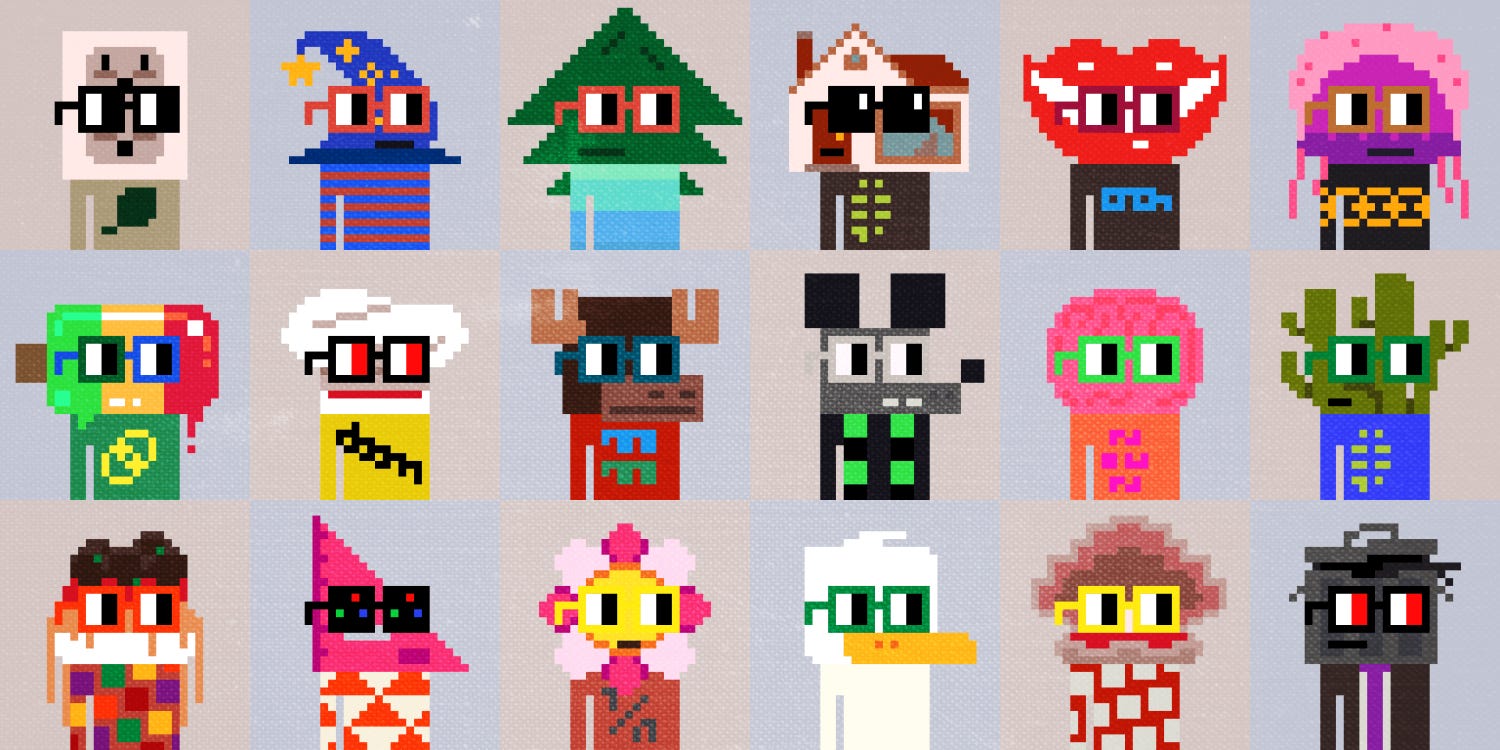
By the way, all pixel art generated by Nouns belongs to the public domain. You can use it without copyrights! Yes, you! And I can to, and so can any other human being with some degree of computer literacy.
You can print it on a t-shirt, or make a movie with one of its characters, no problem, no royalties, no unlawful infringements.
This notion of an open source brand is powerful and quite refreshing: it represents a clean and monumental break away from the notions of intellectual property that ALL previous brands have been built upon. It’s truly something to behold and learn from.
With this new open and swarm-from-all-sides “model”, Nouns becomes a self-reinforcing ecosystem where culture begets capital, and capital begets culture — a kind of economic engine built from art and attention, sustained by the infrastructure of blockchains and the imagination of its participants.
We’ll explore it in more depth in the next sections…
How It Works (roughly)…
Every day at precisely 2 p.m. UTC, a single Noun is born: a 32×32-pixel character, minted forever onto the Ethereum blockchain. One a day gets auctioned, every day, without end.
You’re probably thinking: “bidding real money for some crypto pixel art crap is absurd”, and I get it. But consider that most of humanity works incredibly hard for what we’ve come to call real money, which is just a piece of paper and/or a cypher on your mobile app with no intrinsic value. You can’t do much with a dollar bill’s physical properties, but our collective imagination makes this lousy object quite magical.
Meaning this lousiness doesn’t stop dollars from being the currency that powers millions of transactions every single hour of every single day. It’s how you buy groceries, how you fund the arts, how you pay your bills and buy gifts for your loved ones.
This is the real absurdity, the paradox of capitalism: that, at its core, there’s just a Hungry Ghost powered by a collective delusion.
Back to Nouns. Each Noun is auctioned and its proceeds flow directly into a communal treasury governed by its holders.
That’s it. There’s no roadmap to build against, no pre-mint frenzy, no celebrity drops fueling hype cycles. Just an infinite, open-source organism that marries art and governance, pixels with culture, and ownership with experimentation in public.
…and How It Compares to Other DAOs and NFT Drops
To get at the core of how unusual NounsDAO is, consider its peers. Most NFT collections launch thousands of tokens at once, inflating hype cycles that spike and crash. Many DAOs are short-lived treasuries or private clubs with vague missions, and no real engine behind them.
Nouns avoids both traps through deliberate pace and permanence. By issuing only one NFT per day, it engineers scarcity through rhythm rather than volume. And by storing everything on-chain (i.e.: recorded on an immutable blockchain), it ensures resilience beyond any platform’s lifespan.
Once more, I want to stress the open-source aspect to it all: by releasing its imagery under CC0, NounsDAO invites competitors and collaborators alike to propagate the brand. The result is a kind of cultural flywheel: anyone can make a derivative — Lil Nouns, Nouns Esports, Nouns Coffee — and each success feeds attention back to the parent ecosystem. No trademark lawyers required; just memes defying gravity.
The DAO’s decision-making process also defies typical tokenomics. One Noun equals one vote, regardless of market price. No token weighting, no plutocracy. It’s a small but meaningful stand against the usual “whale rule” dynamics that dominate decentralized governance.
While the world continues to be obsessed with speed and speculation, Nouns’ slow, cumulative rhythm feels quietly, profoundly revolutionary.
Origins and Structure of a Living Artwork
Nouns began in 2021 with a deceptively simple proposition: what if you minted one NFT per day, forever?
The founders — a collective of pseudonymous creators like @punk4156 and @dom — deliberately stripped away the speculative tricks common in NFT launches. No “limited supply.” No exclusive whitelist. Instead, they introduced time as the scarce resource.
Each day’s Noun (referring to the pixel art here) is a unique composition of traits — heads, accessories, backgrounds — generated from open-source code. Neither the code nor the art it produces is locked down behind a license: the art is released under CC0, meaning anyone can use, remix, or commercialize the imagery.
This decision was radical in 2021, when most NFT projects guarded their IP like medieval guild secrets. Nouns, by contrast, made its art a public domain gift, betting that shared creativity would outlast private control.
The second innovation was on-chain governance. Every auction’s proceeds — now totaling hundreds of millions in ETH — flow into a transparent treasury controlled by the community itself. Each Noun grants one vote. Proposals can range from whimsical (funding an animated short film) to strategic (grants to public-goods developers, artists, or nonprofits).
It’s a kind of distributed cultural endowment, where the same community that produces the iconography also steers the deployment of its funds.
Art, Culture, and Governance Intertwined and Funded
Nouns diverges from the speculative mania that defined early NFT culture in important ways. Where many drops treated art as a vehicle for profit, Nouns treats profit as a by-product of collective authorship.
The project’s website calls it “a new kind of on-chain organization that attempts to improve the formation of on-chain avatar communities.”
But that undersells its potential. Nouns is an ongoing study in how culture governs itself when money, memes, and meaning are inseparable.
Traditional art worlds relied on patrons and institutions to sustain creativity — the Medici family funding frescoes, or 20th-century museums collecting avant-garde works.
The DAO, by contrast, turns the patronage model inside-out.
Here, the artwork itself produces the funds to sustain future art. The community decides what’s worth supporting — a documentary, a skateboard brand, an NFT museum, a coffee company — not through curatorial committees, but through votes encoded in smart contracts.
The real artworks is the infrastructure. A self-funding, self-governing organism that blurs the line between medium and movement.
The Cultural Lineage: From Guilds to DAOs
Every era invents new institutions to sustain culture. Medieval guilds maintained craft standards and communal wealth. Renaissance patrons channeled fortunes into public beauty. 20th-century co-ops and artist collectives experimented with shared ownership. Nouns DAO, improbable as it seems, belongs in that lineage — an experiment in digital guild-craft for the 21st century.
But where the guild protected trade secrets, Nouns exposes them. Where the patron imposed taste, Nouns distributes it. Its open-source brand becomes a commons of style, maintained not by hierarchy but by consent. It’s as if Bauhaus had a blockchain and a treasury.
The deeper question Nouns poses is not just what can decentralized governance fund?, but what kinds of meaning can it keep alive? Can a meme, born of pixels and protocols, nurture the same durability as a mural or a folk song? Can culture, once decentralized, sustain continuity without the anchor of institutions?