

Read to the end for trippy and wildly entertaining Ant Farm–related media.
What’s cool about this org?
Ant Farm was established within the counter-cultural milieu of 1968 San Francisco by two architects, Chip Lord and Doug Michels, later joined by Curtis Schreier. Their work dealt with the intersection of architecture, design and media art, critiquing the North American culture of mass media and consumerism. Ant Farm produced works in a number of formats, including agitprop events, manifestos, videos, performances and installations.
Ant Farm embodied, five decades ago, the mad science meets avant-garde rock band meets cybernetic, ecological weirdness we all stand to benefit from today.
They produced work that is – to me – unhinged in a playful, experimental and critical way, constantly challenging us to stay alert and attuned to how our technologies shape environments, and how our ways of living and the environments we live in, in turn, shape technology. They cast our minds beyond well-trodden grooves of thought, using speculative fiction and design as tools for proposing better ecological futures. They defined eco-trippy as a style or vibe we can all apply in a myriad of ways across many different projects and disciplines.
Their radical interdesciplinarity spanned biology, architecture, cybernetics, art, media, activism and beyond. This infused their design practice with planet-centric thinking, where the goal is not to dominate but to attune to the Earth’s systems.
Ant Farm’s work amplified the body of work of designers treating mind, environment, and technology as a single system. In architecture, for example, this allowed them to propose building designs as architectural medium— a radical re-engineering of architecture’s environmental boundaries that transcend the narrow thinking of a structure separate from its environment and other species.
This all makes defining Ant Farm a challenge all of its own. Our current modern world era pushes us towards legibility: clear goals and streamlined processes, and highly-optimized messages to spread the word with precision to oversaturated audiences. Here’s my best stab at summarizing their existence:
Ant Farm’s design practice produced work that is eco-trippy and countercultural in essence; ironic and tongue-in-cheek in style, utopian and visionary in its horizons, and indescribable by nature.
Which makes Ant Farm cool++, cool squared. A short-lived org with an outsized impact in the collective consciousness of the world. In a single decade, between 1968 and 1978, riding the crest of the weave of 1960’s countercultural movements – they managed to produce visionary, trippy and productively outlandish work that is still relevant today, continuing to influence thinkers, architects, creators and designers around the globe five decades after disbanding.
I find their work exhilarating, and incredibly timely for our world’s current and future challenges. I suspect we’ll need more, not less, of this radical interdisciplinarity, and that we’ll want to see more of us engaged in doing work that celebrates and encourages playful experimentation outside environments demanding conformity to rules and uniformity of inputs, outputs and processes.
Their work is perhaps more important now than it has ever been, they are a voice we should listen to, and find ways of echoing what we can lean from its past. In creating the myriad of projects, buildings and performances during their brief but potent existence, Ant Farm anticipated many of today’s most critical design challenges in a number of fields. This eclectic, provocative body of research will continue to stretch our thinking beyond preconceived notions of what is possible, what should be attempted and what would benefit from unencumbered, promiscuous remixing.
The best way to get to know Ant Farm is still through getting to know their work. As you can imagine, it encompasses a range that is uncomfortably vast, crawling out of –and overflowing– any containers it has been jammed into, and notoriously trippy in an entertaining, illuminating way.
Please enjoy.
Dolphin Embassy
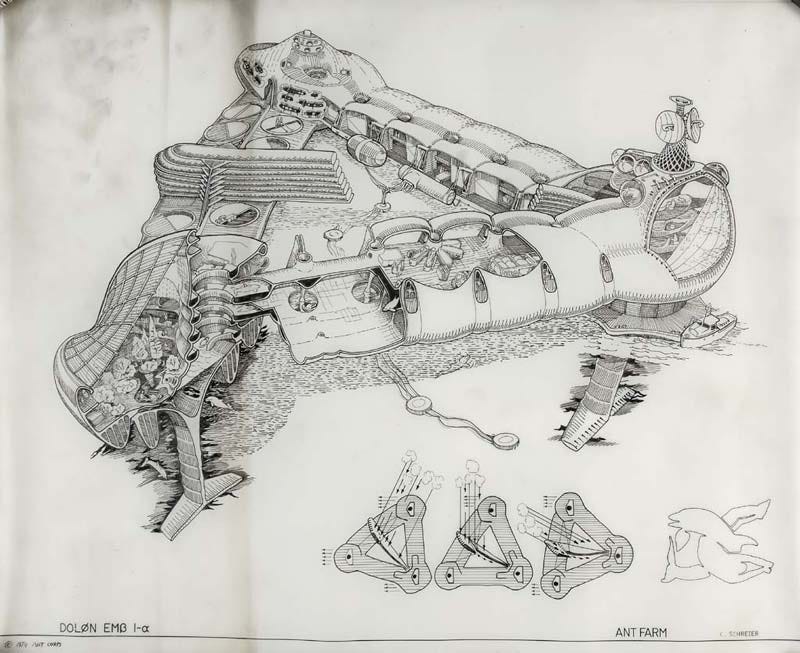
In a 1998 email Doug Michels expounded on what he called his “avant-research” of the mid-1970s. He traces his interest in dolphins, the subject of this “avant-research,” to a nighttime beach party on Padre Island off the coast of Texas near Corpus Christi in 1969. Michels notes that his encounter with dolphins in the wild was otherworldly and hypnotic. He recalls that his skin tingled, “as the dolphins scanned their sonar over our bodies, a not altogether unpleasant sensation.”1 This encounter seems to have had a delayed but consistent effect on Michels, both as a member of the Ant Farm group and in his own practice after the demise of the collective. The strangeness of feeling a dolphin imaging your body via pings of echolocation is a fitting foundational event for Michels—a tantalizingly alien experience that introduced him to a form of mediation of the oceanic environment foreign to most human beings.
House of The Century
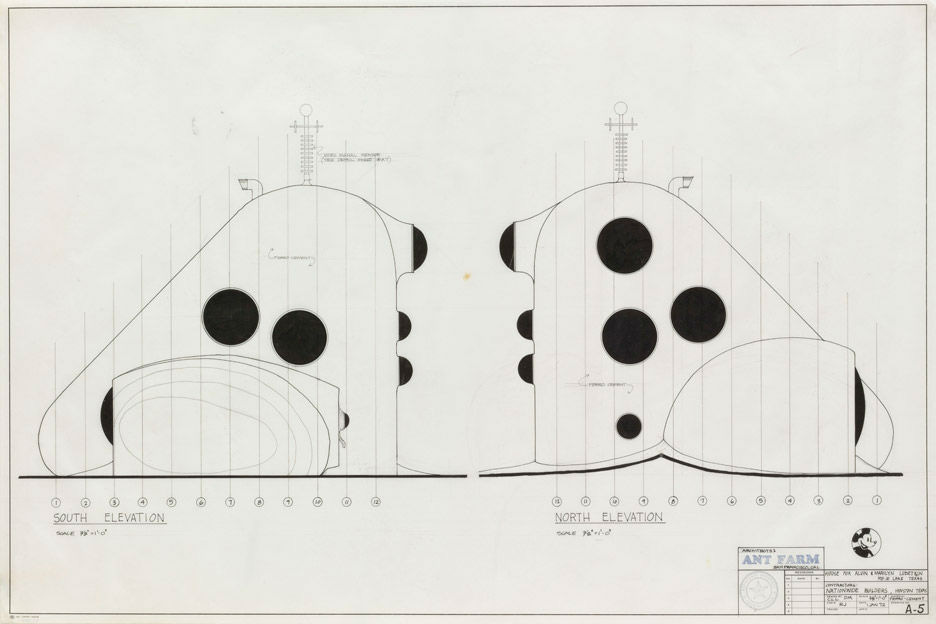
Like all great architecture, this one evokes several interpretations: as an homage to Houston’s Apollo program, as the front of a 1930s Ford, and even as a phallic symbol of the 1960s sex-drugs-and-rock-and-roll era. It also foretold 21st-century interests, such as the creation of biomorphic forms now done on the computer, the construction of buildings using design/build methods, the experimentation with low-cost materials borrowed from other industries, and the reduction of a dwelling’s size for sustainability and affordability reasons.
I highly recommend this gem of a video. It provides a full dose of tripping delight that will make you feel many other conflicting feelings, including nostalgia for the futures we no longer dream of.
“Media Burn”
Ant Farm organized Media Burn, in which two “artist dummies” dressed as astronauts “drove” a customized 1959 Cadillac renamed the Phantom Dream Car at full speed into a wall of flaming television sets. Using the car once again as a cultural icon, Ant Farm addressed the pervasive presence of television in everyday life, affronting the same media they had invited to cover the event. The video is styled after news coverage of a space launch, including melodramatic prestunt interviews with the members of the group and an inspirational speech by a John F. Kennedy impersonator.
https://www.moma.org/collection/works/107284
InflatoCookbook
According to Spatial Agency:
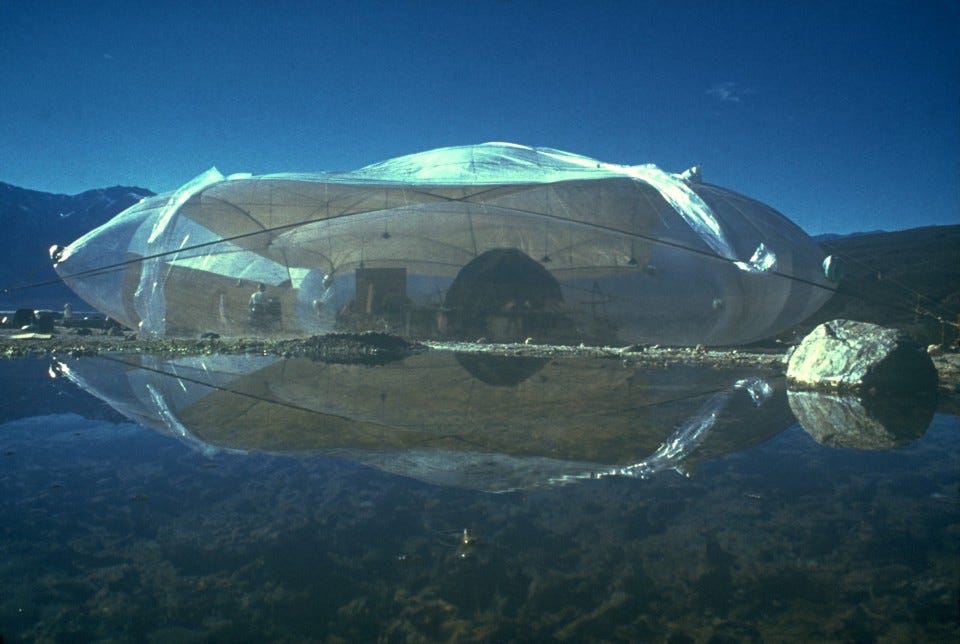
Ant Farm produced a manual for making your own pneumatic structures, the Inflatocookbook. The inflatables thus constituted a type of participatory architecture that allowed the users to take control of their environment. Events were also organised inside the inflatables, which were set up at festivals, university campuses or conferences to host lectures, workshops, seminars, or simply as a place to hang out.
Their early work was a reaction to the heaviness and fixity of the Brutalist movement in contrast to which they proposed an inflatable architecture that was cheap, easy to transport and quick to assemble. This type of architecture fitted well with their rhetoric of nomadic, communal lifestyles in opposition to what they saw as the rampant consumerism of 1970s USA. The inflatables questioned the standard tenets of building: these were structures with no fixed form and could not be described in the usual architectural representations of plan and section. They instead promoted a type of architecture that moved away from a reliance on expert knowledge.
Bluestar (Doug Michels, post Ant Farm)
Another gem of a video…this one about a think tank in space where humans and dolphins live and work together, begins. “The year is 2025.”
Dolphins swimming in water, in space, programming computers via sonar…It is incredibly difficult to describe this video.
So, please enjoy:
https://mediaburn.org/videos/bluestar/
A word on ephemeral orgs…
Think of the many projects designed, created and built by Ant Farm. Their performances, their design sketches, their structures and their buildings. Each of them an ephemeral organization of sorts, coming together to build a stage for, and enact, a play of provocation and introspection, of learning and unknowing.
Consider the process of designing and constructing a building like The House Of The Century. The client/patron who commissions the project. The designers and architects – the sketches drawn and collectively revised, the references and people consulted, the sources of inspiration. All manner of contractors and construction workers coming together to build a structure, and make a statement. Hundreds of people directly involved in the process, for longer and shorter periods of time, with more or less influence, but all essential to the project.
And then, the project is over. Completed. Realized. Ant Farm would go on to work on other projects, but the particular people and activities that were coordinating in order to complete The House Of The Century could not be replicated. It will never be replicated, and yet the project lives on both as a structure and a source of inspiration, and the learnings derived from it remain relevant.
Ephemeral organizations live a short life and die, but their ghosts can come to reanimate future organizations and projects. No organization should be too concerned with having a short or long lifespan; as long as it is a life well lived, the mix of people, circumstances and conditions, principles and patterns that enabled organizations can reshape and become alive, once again, in new ways, leading to the next unimaginable organizations.
…and another word, on gunite and shotcrete
Gunite is the primary building material used by Ant Farm to build The Century House, and also, as it turns out, a monumentally worthwhile rabbit hole.
Gunite – essentially sprayable cement – was invented by a promiscuously multi-faceted man named Carl Akeley. Here are two excerpts from his Wikipedia page:
a pioneering American taxidermist, sculptor, biologist, conservationist, inventor, and nature photographer, noted for his contributions to American museums;
And:
He was also a prolific inventor, perfecting a "cement gun" to repair the crumbling facade of the Field Columbian Museum in Chicago (the old Palace of Fine Arts from the World's Columbian Exposition.[10] He is today known as the inventor of shotcrete, or "gunite" as he termed it at the time […]. Akeley also invented a highly mobile motion picture camera for capturing wildlife, started a company to manufacture it, and patented it in 1915. The Akeley "pancake" camera (so-called because it was round) was soon adopted by the War Department for use in World War I, primarily for aerial use, and later by newsreel companies, and Hollywood studios, primarily for aerial footage and action scenes.[13] Akeley also wrote several books, including stories for children, and an autobiography In Brightest Africa (1920). He was awarded more than 30 patents for his inventions.
Paradoxically, in our current iteration of the modern world, with its overwhelming abundance and endless distractions, feels constricting. A a multi-faceted life like the one Akeley lived feels like a thing of the past, precisely when we need to encourage it most.